

Selling a few cards can start with a simple goal: clear some duplicates and put the money toward something you’d rather keep. The tax questions usually arrive later. A platform sends a form, you can’t find an old receipt, or you realize a trade involved more than the cash adjustment you wrote down.
Those are good reasons to get help before guessing. A qualified tax professional can connect the current rules to your actual records and circumstances. A collecting article can help you prepare that conversation, but it can’t determine your filing position from a card’s sale price.
This is general US information, checked against the linked IRS guidance on October 11, 2026. It is not personalized tax advice. Federal, state and local questions can differ, and the relevant tax year’s rules and your facts control.
A reporting threshold isn’t a tax-free allowance
Form 1099-K reports certain payments. Whether an organization must issue that form is a different question from whether a transaction produces taxable income or how you should report it.
The IRS’s current guidance says third-party settlement organizations generally must report when payments for goods or services exceed $20,000 and there are more than 200 transactions. A form may still be issued below those levels. Payment-card reporting follows different rules.
The IRS FAQs also note that states may have lower reporting thresholds. Don’t use the federal threshold as a target below which you assume records or tax questions no longer matter. Receiving no form doesn’t decide whether you have reportable income.
Keep the form and the underlying platform statements together. The number on an information form doesn’t, by itself, tell you the card’s acquisition history, fees, refunds or the character of the transaction. If you don’t understand the amount, ask for help reconciling it rather than treating it as either a final tax bill or something to ignore.
“I call it a hobby” doesn’t settle the classification
In everyday conversation, you may describe everything you do with cards as a hobby. Tax classification asks different questions about the activity. Enjoying the cards doesn’t automatically resolve those questions, and setting up a seller account doesn’t answer all of them either.
IRS Tax Tip 2026-45, dated June 2, 2026, describes a facts-and-circumstances assessment with no single deciding factor. It includes matters such as profit intent, how the activity is conducted, financial dependence, expertise and changes made to improve results.
A professional needs the actual pattern, not a label chosen because it sounds more comfortable. Explain whether you’re disposing of personal cards, buying items for resale, selling regularly, keeping businesslike records or depending on the proceeds. A mixed situation can deserve a more careful discussion than a yes-or-no online quiz allows.
Don’t assume that a few sales automatically create a business, or that a small amount automatically eliminates a tax issue. Describe the facts and ask which rules apply.
Missing cost records are a reason to ask, not invent
Old collections often have incomplete purchase history. A card may have come from a childhood lot, a trade, a gift or an inheritance. You might know what you paid for a box but not have a supported amount for each card inside it.
Preserve what you do know: acquisition method, approximate date clearly labeled as approximate, original lot receipts, messages and any other supporting records. Separate confirmed amounts from recollection. Ask the professional what evidence is useful and how uncertainty should be handled.
Don’t enter zero as a substitute for an unknown acquisition amount. Don’t decide that the favorite card absorbed all of a lot’s cost and every remaining card was therefore free for tax purposes. A convenient personal tracking choice is not automatically a defensible tax treatment.
Gifts, inherited property and noncash trades can involve distinct rules. Keep their history visible and ask about it specifically. A trade with no money changing hands can still raise questions that a cash-only log doesn’t capture.
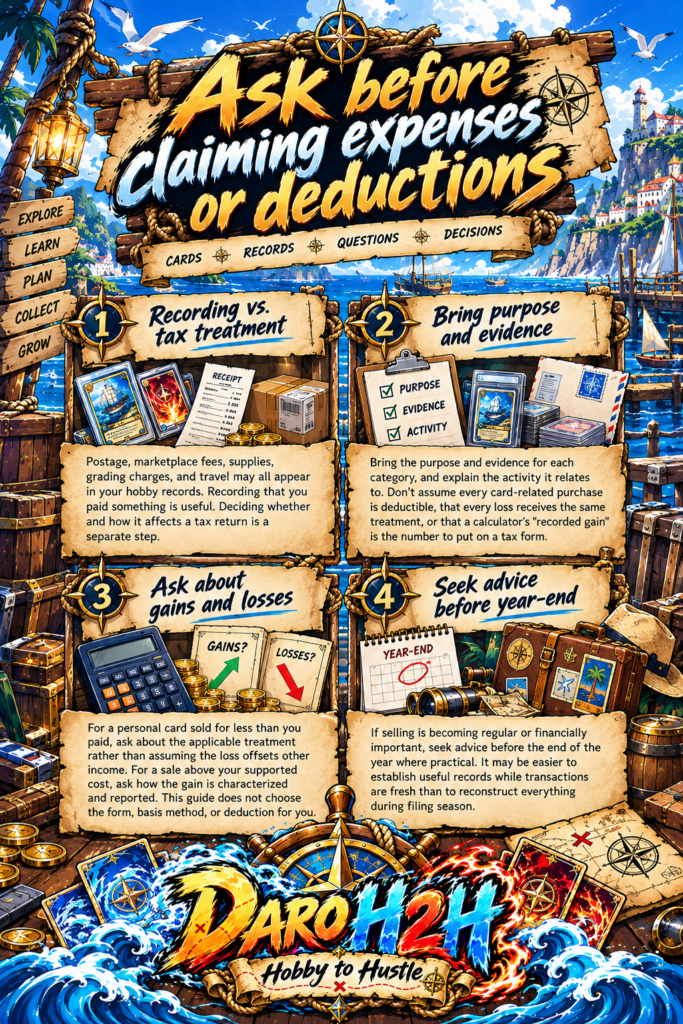
Ask before claiming expenses or deductions
Postage, marketplace fees, supplies, grading charges and travel may all appear in your hobby records. Recording that you paid something is useful. Deciding whether and how it affects a tax return is a separate step.
Bring the purpose and evidence for each category, and explain the activity it relates to. Don’t assume every card-related purchase is deductible, that every loss receives the same treatment or that a calculator’s “recorded gain” is the number to put on a tax form.
For a personal card sold for less than you paid, ask about the applicable treatment rather than assuming the loss offsets other income. For a sale above your supported cost, ask how the gain is characterized and reported. This guide does not choose the form, basis method or deduction for you.
If selling is becoming regular or financially important, seek advice before the end of the year where practical. It may be easier to establish useful records while transactions are fresh than to reconstruct everything during filing season.
State and marketplace questions need their own answers
A marketplace’s handling of a payment or tax field doesn’t settle every obligation you may have. Your location, where and how you sell, and the activity itself can matter. Ask about state reporting, any applicable sales-tax questions and sales made outside a platform.
Keep these questions separate from the federal income-tax discussion so they don’t get lost. A professional who helps with one area can tell you whether another specialist or state agency guidance is needed.
If you sell across borders or receive payment in unfamiliar forms, flag that explicitly. Don’t assume a general US domestic card-sale example covers currency conversion, duties or other jurisdictions.

Bring a small, organized packet
You don’t need to arrive with every answer. You do want the facts in a form someone else can follow. Useful records include:
- Platform transaction and payout statements, along with any information forms received
- Purchase receipts, order confirmations and acquisition notes
- A list of sold or traded cards and lots with dates and supported identity details
- Shipping, fee, refund and other relevant payment records
- Gift, inheritance, noncash-trade and missing-record notes
- A short description of how often you sell, why you acquire cards and what you intend to do with the activity
Add the questions you want answered. “How should I handle this lot with incomplete acquisition records?” is more useful than “Do I owe tax on cards?” It points the discussion toward the actual uncertainty.
Use the professional’s secure document-sharing process for records containing tax identifiers or financial information. A general collection wishlist doesn’t need those details, and public hobby groups aren’t the place to post a tax form for strangers to diagnose.
Quick questions
If I don’t get a 1099-K, can I ignore the sales?
No. Form issuance and tax treatment are separate questions. Keep the records and determine the applicable reporting requirements for your circumstances.
Does getting a 1099-K mean I’m running a business?
The form alone doesn’t make that decision. A professional needs the facts about the activity and transactions, not just the presence of an information form.
Can Daro H2H’s calculator work out my taxable gain?
No. It models entered proceeds and costs for a limited recordkeeping purpose. It doesn’t determine tax basis, classification, deductions or filing requirements.
Make a question list while the records are fresh
Start with the transaction you least understand, gather what supports it and write down what is missing. Then take that focused question, along with the broader selling picture, to a qualified professional. You don’t need to become a tax specialist to keep useful records and know when the next answer belongs with one.