
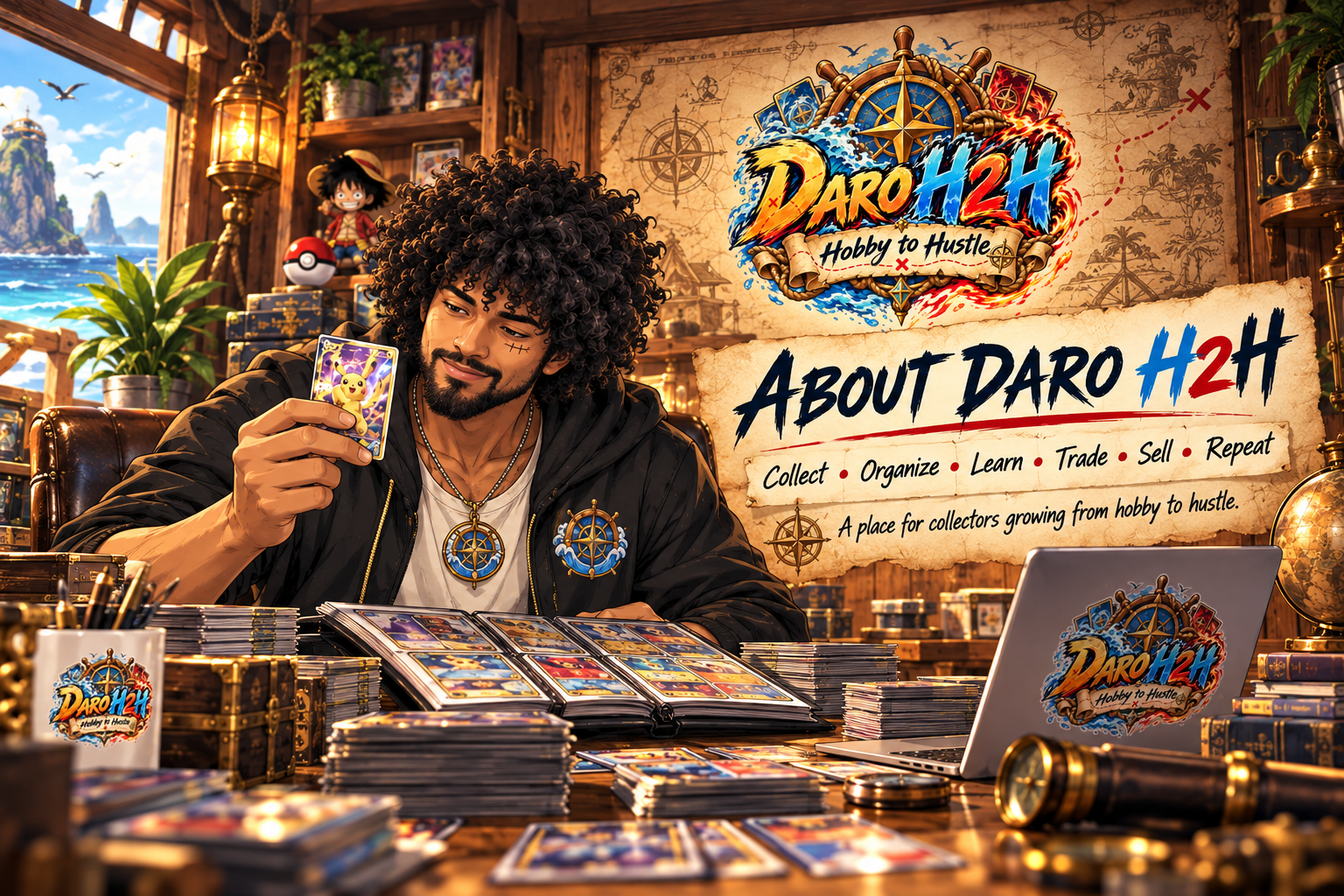
Some cards are worth chasing because they’re rare. Others are worth keeping because they remind you of a favorite character, a scene, a game you grew up with, or artwork you just can’t stop looking at. Daro H2H is for the second kind of excitement just as much as the first.
We’re building a place for people who like collecting cards and want to get a little better at it. Pokémon and One Piece are where the game-specific coverage starts, but the site isn’t supposed to be locked to those two forever. Good collecting questions come up whether you’re putting together your first binder page or you’ve got boxes of cards you’ve been meaning to sort.
Hobby to Hustle doesn’t mean everything has a price tag
You don’t need to turn your cards into a business to belong here. If your idea of a great collection is one binder packed with favorite artwork, awesome. If trading a duplicate for something you’ve been chasing sounds like a win, that works too. And if selling some extras helps pay for your next pickup, there’s nothing wrong with learning how to do it well.
That’s what Hobby to Hustle means on this site: enjoy the cards first, then use practical buying, trading, organizing, and selling skills when they actually make the hobby better. It’s not an invitation to treat every pack as an investment or every collector as a future full-time seller.
We can talk about money without making it the whole conversation. Prices matter when you’re choosing between cards or figuring out whether a sale is worth the work. They aren’t the only reason a card belongs in your collection.
What you’ll find here
The guides are built around questions people really run into. How do you decide what to collect? How can you tell which printing you’re looking at? What sleeves actually fit? When is grading worth considering? How do you compare a trade without getting caught up in somebody else’s hype? And if you decide to sell, what do you need to know before you pack up the card?
Some articles stay focused on one quick answer. Others take their time with a bigger decision, because a couple of bullet points won’t always cut it. We also develop worksheets, checklists, and calculators for jobs that are easier when you’ve got something you can fill out or run yourself.
We want the material to make sense to someone who’s just starting out without talking down to the collector who already knows the hobby. If a detail is different for Pokémon and One Piece, the guide should say so. If a term might be unfamiliar, we’ll explain it instead of expecting you to look it up somewhere else.
Who writes the Daro H2H articles?
When you see By Daro H2H, you’re reading a guide published under the site’s name. That tells you it’s part of the researched editorial library. It does not mean one person personally pulled every card, tested every binder, completed every trade, or made every sale described in the article.
The writing is meant to sound like a collector talking to another collector: relaxed, clear, occasionally funny, and actually interested in the cards. But the personality of the prose isn’t a substitute for firsthand evidence. Research-based advice is labeled and treated as research-based advice.
AI tools may help with research organization, drafting, and editing. That doesn’t make an AI-generated opinion into a hands-on review, and it doesn’t replace checking claims against appropriate sources. When a contributor eventually shares real purchases, collection photos, tests, videos, or selling experiences, that material can carry the contributor’s own byline and clear attribution.
How we try to get the details right
Card collecting has a lot of details that seem tiny until they matter: the exact set number, an alternate finish, a condition difference, a different sleeve size, or a marketplace rule that changed since the last time someone checked. Getting those things wrong can make otherwise good advice pretty useless.
For information that needs checking, we prefer the original source when possible: official card databases, publishers, manufacturer specifications, grading-service documentation, marketplace policies, and other authoritative guidance. We also distinguish what a manufacturer claims from what an independent reviewer actually tested, and what the collecting community thinks from what we can confirm.
We won’t claim a product was tested when it wasn’t, quote a seller experience that never happened, or make up what somebody paid for a card. If the evidence is limited or an answer depends on your situation, we’d rather say that than pretend there’s one perfect answer.
What about product links and recommendations?
A recommendation has to be useful even if nobody clicks a shopping link. Sometimes the right answer is a basic sleeve, a cheaper binder, buying the single instead of more packs, or simply using what you already own.
Some pages may eventually include affiliate links, which can earn the site a commission when a qualifying purchase happens. Those relationships shouldn’t change the conclusion, and any article using affiliate links should disclose them near the relevant content. We don’t describe product comparisons as personal tests unless actual testing took place.
Corrections, changes, and unfinished guides
Card sets, fees, products, grading rules, and platform policies don’t stay frozen in time. A guide might need an update after a manufacturer changes a product or a marketplace adjusts its policies. We aim to keep important claims connected to reliable sources and correct them when something changes.
Daro H2H is still in its staging build. Some pages and resources are being completed, and a dedicated public contact and correction route is part of the remaining launch work. Until that route is ready, we don’t want to pretend there’s a working support desk behind a button that goes nowhere.
Ready to find your collecting lane?
If you aren’t sure what to do first, Start Here will point you toward the part of the hobby you’re working on. And if you’re building or rebuilding a personal collection, Choose a Collection You’ll Enjoy Keeping is a good place to jump in. The point is to end up with cards you’re actually happy to own—not just another list of stuff you’re supposed to buy.