
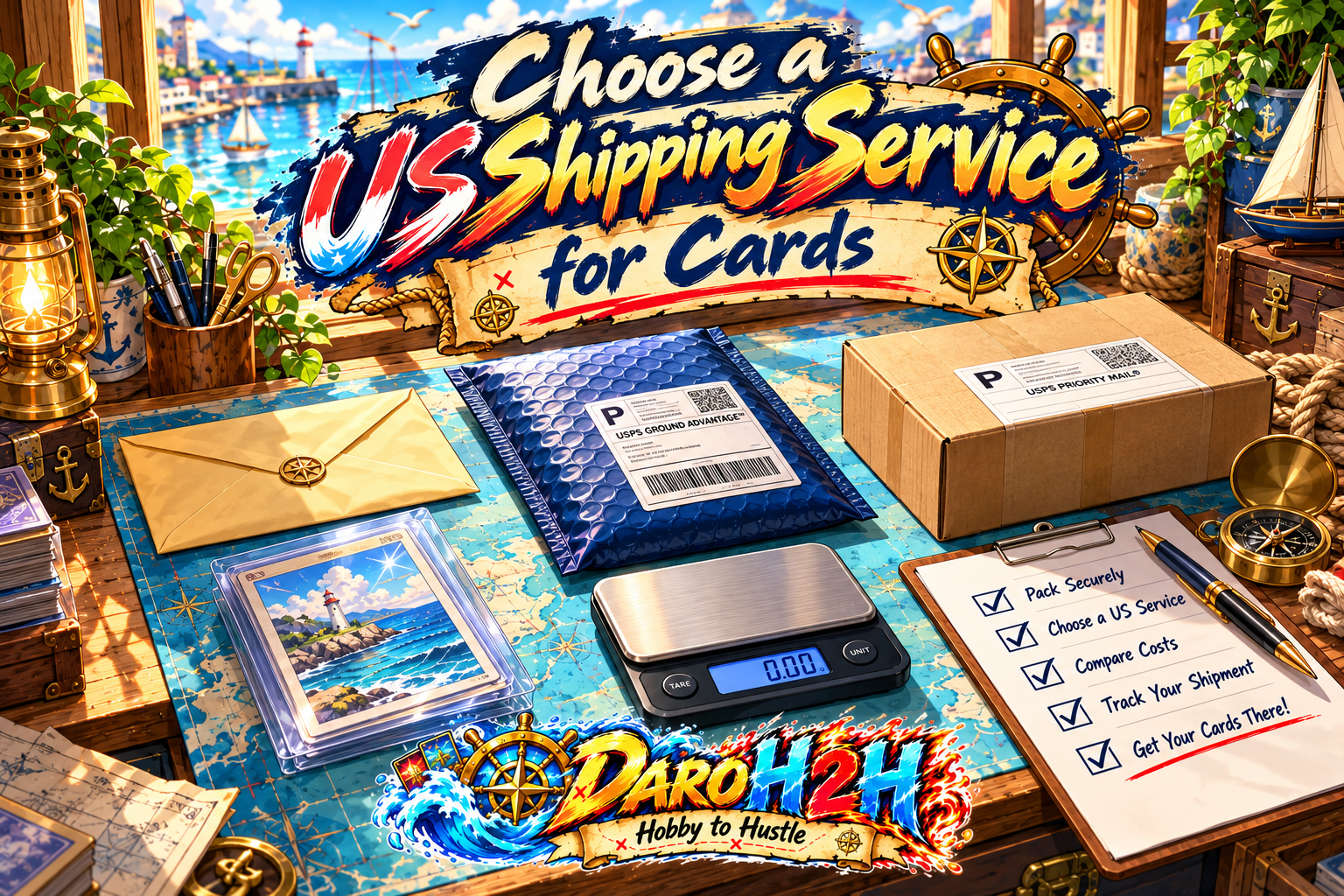
The card sold. Now the shipping menu is offering several prices, and the cheapest one looks pretty appealing. Before choosing it, put the packed item on the scale. The service has to fit the shipment you built, the order’s requirements and the kind of delivery evidence you need.
For US card shipments, the useful sequence is pack, measure, weigh, check the rules, then buy the label. Starting with a cheap label and trying to make the card fit its limits can push you toward the wrong package or inadequate protection.
This guide compares the decisions rather than maintaining a postage-price chart. Rates and program rules change, and the current carrier or marketplace checkout is where you should confirm the exact service you’re about to use.
Start with the complete mailpiece
The card, sleeve and holder are only part of the weight. Add the bag, reinforcement, padding, envelope or box, paperwork and label. Measure the outer dimensions of the finished package and assess its shape, thickness and flexibility.
A package can be light and still fail a letter service’s rules. A rigid mailer may need different handling from an ordinary flexible envelope. A thick stack can create a lump even when it slides into a familiar envelope size. “It weighs almost nothing” doesn’t answer those questions.
The USPS Domestic Mail Manual’s physical standards explain the distinctions. If you can’t confidently classify your finished shipment, ask USPS to assess it rather than guessing. Adding a stamp or writing “do not bend” doesn’t change the physical requirements of the service.
Keep the protection appropriate to the card. If the parcel needs to be thicker or sturdier, compare services that accept that package. Saving a little postage by weakening the packing isn’t much of a saving if it creates a damaged order.
Separate ordinary envelopes from marketplace envelope programs
An envelope is a package shape. A named marketplace shipping program is a service with its own eligibility and process. Those are different things, even when the parcel looks similar on the desk.
eBay standard envelope is available for eligible transactions and categories, including trading cards. It includes limited integrated tracking and conditional shipment protection, with specific requirements for the packed envelope. That doesn’t mean an ordinary stamped envelope gains the same features.
Check the live program page and the actual order’s eligibility before selecting it. Review the permitted item and order value, size, weight, thickness, flexibility, destination and any quantity restrictions that apply. A label option appearing in a menu isn’t a reason to ignore a packing requirement.
Limited tracking should also be understood on its own terms. Don’t promise a buyer that every scan or delivery detail will work exactly like a tracked parcel. Explain the service accurately if a question comes up, and use the program’s actual help or claim process when appropriate.
A parcel service may fit the item better
A slab, a thicker lot or a shipment needing a more protective box may point you toward a parcel service. Compare options using the package’s actual dimensions, weight and destination, along with the delivery needs of the order.
USPS Ground Advantage is one official parcel-service reference to check. Other eligible carrier services may suit the shipment too. This isn’t a claim that one service is cheapest or best for every card; the quote and requirements need to match your particular package.
Read delivery estimates carefully. An estimated arrival range isn’t automatically a money-back delivery guarantee, and buying a faster service doesn’t remove every disruption risk. Don’t promise a date in a listing unless you understand what the service and your own handling time can support.
Check the label source too. Retail counter prices, online labels and marketplace arrangements may not be identical. Use an authorized route for your transaction, and compare the total you will actually pay rather than a promotional “from” price.
Meet the marketplace’s rules as well as the carrier’s
A carrier accepting the parcel doesn’t automatically satisfy the marketplace’s seller requirements. The platform may require particular tracking or signature arrangements, supported carriers and shipment evidence. Read the order guidance before dispatch, when you can still choose the right service.
As checked on October 11, 2026, TCGplayer’s customer-order guidance requires tracking or delivery confirmation for orders over $49.99 and signature confirmation for orders over $250. Those are TCGplayer’s stated thresholds for that guidance, not universal USPS rules. Recheck them for your current order.
The destination matters as well. Use the address supplied through the order’s authorized process. If someone asks you to send to a different address in a message, check the platform’s procedure before changing it; an informal change can affect the evidence or protection attached to the transaction.
A grading submission or marketplace-program intake is a separate workflow. It may have packaging, address, declared-value and service requirements that don’t match a customer sale. Follow the recipient’s current instructions, even if you ship cards to buyers regularly.

Know what protection means before relying on it
Tracking, signature, insurance and marketplace shipment protection address different questions. Tracking records events. A signature service adds a delivery-related step under its terms. Insurance or a protection program may provide a claim route for eligible losses, subject to coverage, evidence and limits.
Read the details before assuming a collectible is covered for the amount you have in mind. Check who provides the coverage, what it applies to, how value is established, what packaging obligations exist and when a claim must be filed. Keep receipts and the order record so you’re not trying to reconstruct the item and sale afterward.
Coverage does not guarantee that a unique card can be replaced. A favorite with particular personal significance may be difficult to replace even if an eligible financial claim succeeds. For a trade or submission, consider that consequence alongside the money amount.
You can reduce risk without pretending to eliminate it. A careful packing plan, suitable service and complete record are useful. None justifies calling a shipment risk-free.
Buy the label after one last order check
Confirm the recipient, service, return address, weight and dimensions before purchase. Check whether the label includes the features you intended, such as tracking or required signature service. Don’t assume an optional feature was added merely because you considered it earlier.
Use the carrier’s appropriate handoff method and retain the dispatch evidence available for that service. A created label is different from an accepted shipment. Where the service provides an acceptance receipt, keep it with the order record.
Upload or confirm tracking through the platform’s correct workflow and keep the buyer’s expectations realistic. If something changes materially, communicate through the transaction channel. A clear message about a delay is more helpful than silently hoping the tracking page will explain it.
A small shipping desk can stay small
For occasional sales, accurate measurement and a reliable way to produce a readable label matter more than having a warehouse-style setup. A dedicated label printer may be convenient with regular volume, but it isn’t a prerequisite for mailing a few cards.

Quick questions
Is a rigid card mailer eligible for ordinary letter postage?
Not automatically. Classification depends on the finished item’s dimensions, thickness, rigidity and other applicable standards. Have the carrier check it if you’re unsure.
Does a tracking number prove what was inside?
No. It records shipment events according to that service. Keep listing and packing evidence too, while recognizing that each claim process decides what evidence it requires.
Should I buy a thermal printer for my first few sales?
Only if it solves a real need at a sensible cost. Use an available compatible label-printing method and focus first on accurate package measurements and the right service.
Choose for one real package
Finish packing one order and write down its dimensions, weight, destination and marketplace requirements. Compare current eligible services using those inputs. Keep the quote with the order and check the item, address and selected service one final time before dispatch.