

You finally pulled a card you’ve been chasing. Nice. Now comes the part nobody thinks about when they’re celebrating the pull: where’s that card going? Into a binder? A rigid holder? Some mystery sleeve you found in a drawer that might be a little too tight?
Protecting a collection isn’t about buying the fanciest plastic you can find. It’s about using something that fits the card and makes sense for what you’re doing with it. A cheap sleeve that’s the right size is more useful than a premium-looking holder that puts pressure on the corners. And if a card already has a little wear, the wrong fit isn’t going to magically fix it.
Let’s sort out the different kinds of sleeves and holders, when they’re worth using, and the checks to make before you spend money on a whole stack of supplies.
Start with the card, not the packaging
When a product says it fits ‘trading cards,’ it’s tempting to assume you’re good. But trading cards come in different sizes, and some are noticeably thicker than others. A sleeve that’s fine for one standard card might be wrong for another kind of collectible, even if both came from a card shop.
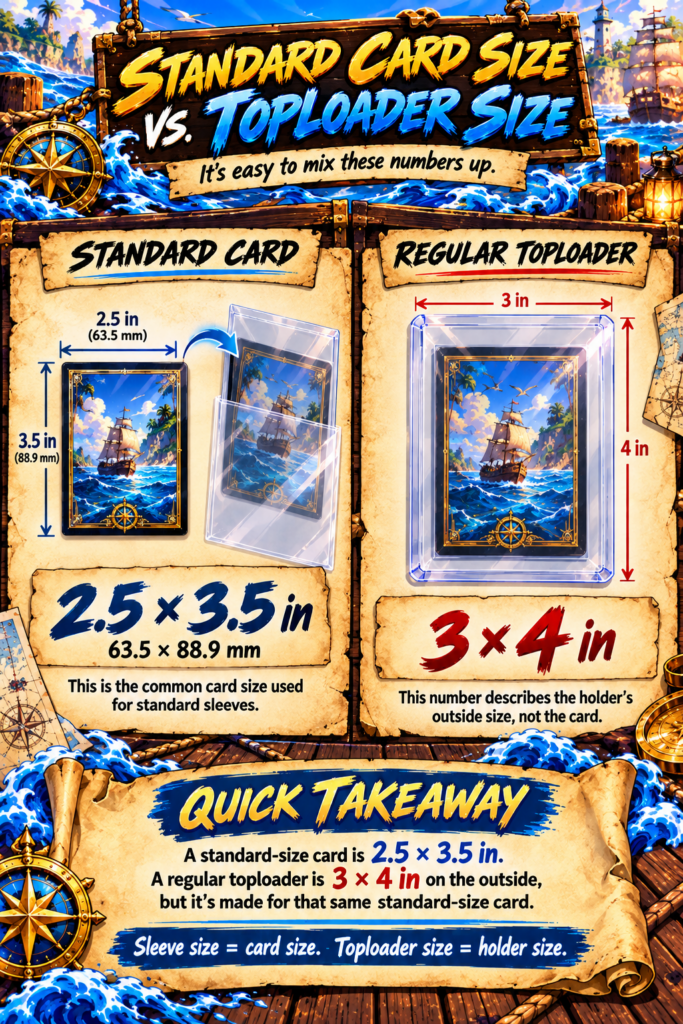
A common standard size is 2.5 × 3.5 inches (63.5 × 88.9 mm). That is the card size Ultra PRO specifies for its standard Premium Card Sleeves. Its regular toploaders are designed for that same standard-size card, but their 3 × 4-inch measurement describes the outside of the holder. It’s easy to mix those numbers up if you’re comparing listings.
You’ll also see thickness limits expressed in points or ‘pt.’ The particular Ultra PRO sleeves and regular toploaders linked above are specified for standard-size cards up to 35pt. That does not mean every sleeve or holder on the shelf has the same rating, and it doesn’t mean you should force a thick card into a regular holder to test the label.
Before ordering anything, check the actual card dimensions and the manufacturer’s stated fit. If the listing only says ‘universal’ or ‘for most cards,’ keep looking until you can find a real size. That’s especially important with oversized cards, unusually thick inserts, and card formats outside the familiar standard.
The basic soft sleeve: simple for a reason
For a lot of collectors, a basic soft sleeve is the first thing a card goes into. It keeps the card from rubbing directly against other surfaces during ordinary handling and storage. It isn’t armor, and it won’t prevent bending by itself. But for something inexpensive and easy to replace, it does a useful job.
There are different versions of a ‘soft sleeve.’ A loose-fitting penny sleeve leaves a little space around a standard-size card; an inner or exact-fit sleeve is intended to be closer to the card’s dimensions. That can matter if you want to double-sleeve cards or put them into another holder. It also means the word ‘sleeve’ on a product listing isn’t enough information on its own.
Material is worth checking, too. Ultra PRO describes its Premium Card Sleeves as polypropylene that is acid-free, non-PVC, and archival-grade. That’s the manufacturer’s specification for that product, not proof that every inexpensive sleeve uses the same material or has been tested by us. If long-term storage is your goal, check exactly what the brand says the sleeve is made from instead of assuming all clear plastic behaves the same way.
You don’t have to sleeve every low-value bulk card individually if that doesn’t fit how you collect. On the other hand, cards you handle often, carry to trades, or keep in a favorite binder may deserve a little extra protection. Make that call based on the card and how you’ll use it, not just whether somebody called it valuable.
When a toploader makes sense
A toploader is the familiar rigid sleeve you see all over card shops and listings. It gives the card more structure than a soft sleeve can. If you’re sorting cards that need extra protection, transporting a small group, or preparing something for a sale, that added rigidity can be helpful.
The common setup is a compatible soft sleeve inside a toploader. The sleeve provides a layer between the card and rigid plastic. Ultra PRO actually lists compatible soft sleeves alongside its regular toploaders, which is a more useful compatibility signal than two unrelated listings that happen to look similar.
Here’s where people get into trouble: a rigid holder is not supposed to be a wrestling match. If the combination catches the corners or needs force to slide in, stop. It might be the wrong size, the wrong thickness, or simply a bad combination of products. Test an unfamiliar setup cautiously with an ordinary card before using it on one you really care about.
And a toploader isn’t a complete shipping plan by itself. If you’re mailing a card, you still need to think about movement, moisture, the outer package, and the carrier’s rules. USPS warns that rigid objects in ordinary machine-sorted letter envelopes can cause problems and recommends padded mailers or small boxes for rigid or bend-sensitive items. Check the service you’re actually using before deciding how to pack the order. USPS explains the letter-versus-package distinction here.

Binders are for enjoying cards, not just counting pockets
A binder’s job is pretty great: you can open it up and actually enjoy your collection without juggling a loose stack. The catch is that the binder’s advertised capacity is only part of the story.
Say a binder claims 360 spots. That usually tells you how many card positions are available. It doesn’t prove your chosen sleeves fit comfortably, that every pocket will take a double-sleeved card, or that a completely full binder will close the way you want. Pocket size, sleeve thickness, page construction, and how the binder is loaded all matter.
Think about the way you actually browse. Do you want one page dedicated to your favorite character? A Pokémon binder and a separate One Piece binder? A few cards by the same illustrator together? That changes which page layout feels useful. A smaller binder that’s easy to flip through might make you happier than a giant one you never take off the shelf.
Try fitting a few ordinary cards in the sleeve-and-pocket combination before filling every page. If you see obvious pressure, curling, or trouble sliding cards in and out, fix the setup. The cards aren’t going to thank you for hitting the advertised maximum capacity.
Semi-rigid and magnetic holders have different jobs
Semi-rigid holders are another way to give a card structure, though they don’t behave exactly like a toploader. You may see them discussed when people are preparing submissions for grading. That’s a reason to check the specific grading service’s current packaging instructions, not a reason to assume any semi-rigid holder is automatically acceptable.
Magnetic holders are popular for displaying a standout card. They can look clean on a shelf, but they come with thickness ratings and fit requirements of their own. A holder intended for one thickness isn’t necessarily a good idea for a much thinner or thicker card. Some display setups also expose cards to more light and handling than ordinary storage. Think about the whole environment, not just how cool the display looks.
You don’t need a magnetic case for every card you like. In fact, you can build an awesome-looking collection with well-organized binders and some basic supplies. If a premium display doesn’t solve a real problem for you, there’s no rule saying you have to buy it.
A quick fit check before using a new holder
The first time you try a new sleeve, binder, or rigid holder, take thirty seconds and actually watch what the card is doing. It sounds obvious, but it’s easier to spot a bad fit before you’ve loaded twenty cards into the same setup.
- Check dimensions and thickness. Start with the actual card, then match the product’s stated specifications.
- Inspect the holder. If it is dirty, visibly damaged, or has an edge that might snag the card, don’t use it.
- Try the insertion gently. There should be no corner bending or need to push through resistance.
- Look at the finished fit. Check for pressure, shifting, exposed edges, or a card that could slide free too easily.
- Test the whole setup. A sleeve might fit the card but not the binder pocket or toploader you intended to combine it with.
If something feels wrong, stop and swap it. Protecting a card shouldn’t be the activity most likely to damage it.
What about storing the collection long-term?
A good holder is only part of taking care of cards. A box in a damp basement, a binder baking in direct sun, or cards piled where they’ll get crushed can cause problems even when every card has a sleeve.
Aim for a clean, dry place with stable indoor conditions, away from water, direct sunlight, and places where somebody might drop heavy stuff on the collection. Handle cards with clean, dry hands. If you’re building an especially valuable or fragile collection, it may be worth seeking specialist preservation guidance rather than guessing that an expensive holder solves everything.
That doesn’t mean you need museum equipment for a stack of favorite commons. It just means common-sense storage conditions and good habits do a lot of the work.
What I’d buy first—and what can wait
If you’re starting with a normal binder collection, I’d look at the right-size soft sleeves and a binder or storage setup that actually fits them. Add a few compatible rigid holders for special cards, transport, or situations where you want more structure. That’s a practical starting point without turning a small hobby purchase into a shopping spree.
If you already have sleeves and a binder that fit well, use them. Don’t replace perfectly good supplies because a new brand has nicer packaging. Save that money for a card you actually want—or just keep it.
Before buying anything more specialized, decide what job you’re trying to solve. Displaying one card? Mailing an order? Following a grading service’s submission requirements? Those are different tasks, and they may call for different supplies.
Quick questions collectors ask
Are 3 × 4-inch toploaders made for 3 × 4-inch cards?
Not in the standard Ultra PRO example above. The 3 × 4 inches describes the rigid holder’s outside dimensions. That model is designed for standard 2.5 × 3.5-inch cards up to the thickness stated on its listing.
Do I need an inner sleeve and a penny sleeve for every card?
No. Double-sleeving is a choice for a particular purpose, and only if the layers fit properly. A single compatible soft sleeve may be plenty for many collecting setups.
Will putting a card in a toploader make it safe to mail?
Not automatically. You still need an appropriate shipping method, outer packaging, and a way to keep the card from moving or getting bent. The carrier’s rules matter.
Should I always buy the thickest or most expensive holder?
Nope. Buy for the card’s size, its actual protection needs, and what you’re going to do with it. A fancy but badly fitting holder isn’t a win.
The next move
Grab one ordinary card and see how it fits in the sleeve, holder, or binder pocket you already own. If the setup works, great. If not, check the exact size before ordering something else. Once your cards have good homes, go back to the fun part—actually enjoying the collection.
Need a reminder of what you’re collecting toward? Start with a collecting goal you actually care about. The other gear and storage guides are still being reviewed and will join the site as they’re ready.