
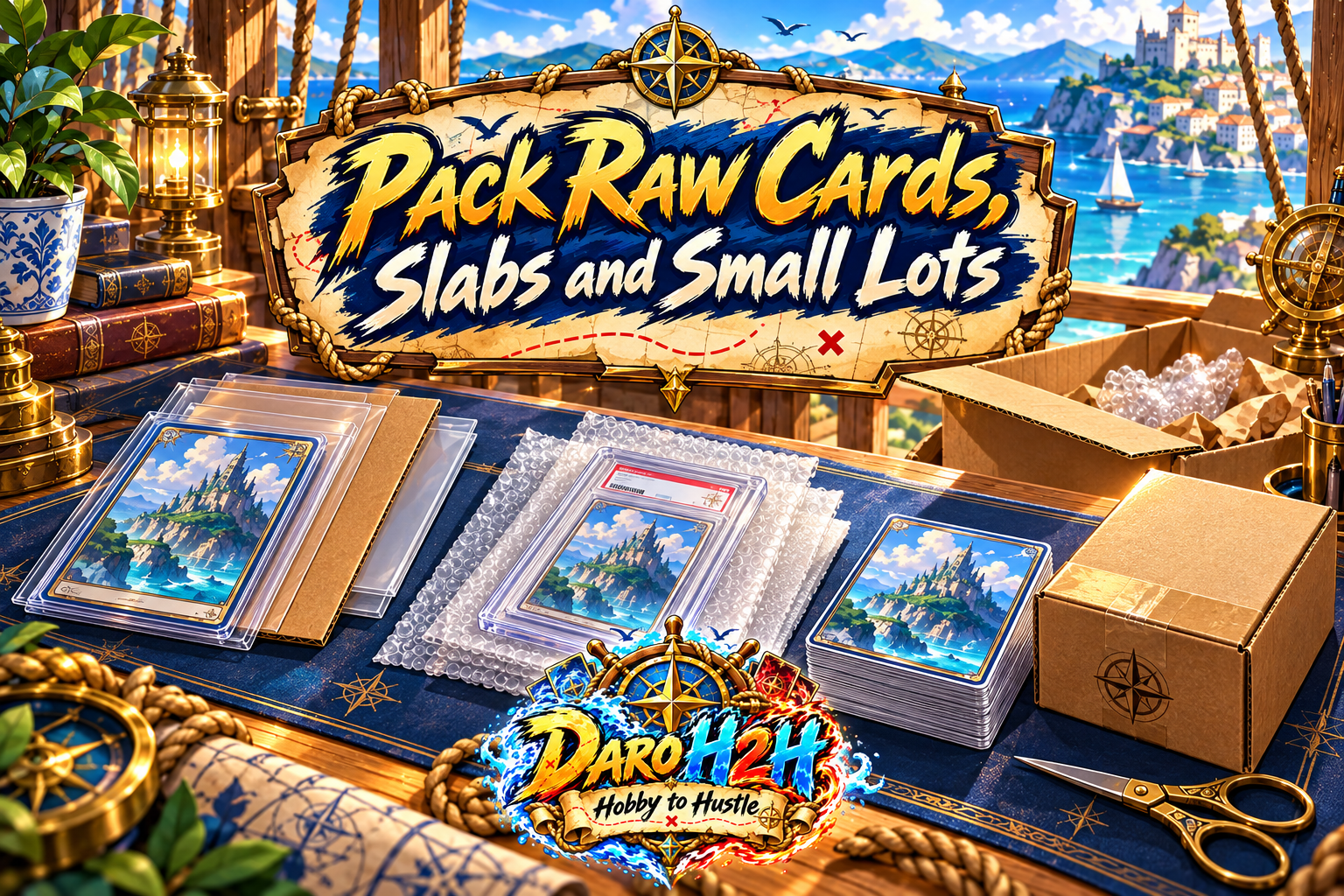
A card can be carefully sleeved and still have a rough trip if it slides out, gets crushed inside the mailer or meets a strip of tape when the buyer opens it. Good packing considers the whole journey, including the final few seconds when someone is trying to get their new card out.
The basic job is to keep the card supported, contained and separated from things that can damage it, then choose an outer package and shipping service that suit the finished parcel. Raw cards, slabs and small lots don’t all need the same arrangement.
This guide explains a research-based approach. It isn’t a claim that one packing recipe has been physically tested by Daro H2H or will prevent every kind of damage. Follow the current instructions for the actual marketplace, carrier or submission program you’re using.
Begin with the card and holder that actually fit
Before adding a single layer, check the item’s size and thickness. A sleeve should accept the card without forcing corners or squeezing it into a space designed for something thinner. The next holder must fit the sleeved card, not just the card’s nominal dimensions.
If the fit feels wrong, stop and use appropriate protection. More pressure doesn’t make a tight holder safer. Thick cards, oversized cards and unusual formats can need different supplies from ordinary thin trading cards. Choose Sleeves and Holders That Fit covers that first decision.
For ordinary customer orders, TCGplayer’s shipping guidance starts with a soft sleeve, additional protection and control of sliding. It also emphasizes that the buyer needs to be able to unpack the card without damaging it. Those are useful principles, but the finished package must still meet the chosen shipping service’s rules.
Keep the work surface clean and uncluttered. Check that you’re packing the exact copy, language, version and quantity from the order. Protective packaging can’t fix sending the wrong card extremely carefully.
Give a raw card support without creating a trap
A compatible top loader or other appropriate holder can support a sleeved card, but support is only part of the job. Think about where the openings are and whether the card could work its way out during handling. A suitable resealable outer bag can help keep the protected card together without putting adhesive near its surface.
Don’t attach tape directly to a card, sleeve opening where it can touch the card, or collectible surface. If a closure uses tape, keep the adhesive safely away from the item and make the opening route obvious. The buyer shouldn’t need to drag a blade beside the card to reach it.
Extra reinforcement may be appropriate for a parcel, but “more rigid” isn’t automatically compatible with a letter service. Adding thick cardboard can change the final package’s rigidity and thickness. If better protection takes the shipment outside a service’s limits, choose a suitable service rather than removing necessary protection to chase a cheaper label.
Use the amount of containment the actual item needs. Wrapping a single protected card in endless layers of tape can make it harder to inspect and open without adding useful protection. A clean arrangement that stays together and opens deliberately is the goal.

Treat a slab as an item that needs protection too
A graded holder isn’t a shipping box. The case can be scratched, cracked or damaged, and its corners can receive force through a thin outer wrapper. Protect the slab’s surface with suitable nonabrasive containment and use cushioning and an outer package appropriate to its size and the trip.
Check that cushioning remains around the item when the package is closed. If the slab is pressed against a box wall or can travel freely from one end to the other, the empty space isn’t doing you any favors. The package should contain the protected item without crushing it.
For multiple slabs, keep them from knocking against one another. Separate and cushion them as appropriate, then make sure the group is contained inside the outer package. Don’t assume placing several hard cases together makes them mutually protective.
Avoid promising that a particular small box fits every slab. Holder formats vary, and the space required includes protection around the holder. Measure the actual arrangement before deciding a box is suitable.
Pack a small lot as a group, not a loose stack
With a lot, you need to protect individual cards and control movement within the group. Loose cards can shift into edges, corners or gaps even when the outer mailer looks secure. Choose appropriate sleeves and containment for the cards, their condition and the transaction.
Don’t force multiple cards into a holder intended for a different thickness just because they appear to fit with pressure. Split the group into sensible protected units when needed. Then prevent those units from sliding around or pushing against each other in the outer package.
Make the contents easy to account for. A packing slip or short order reference, placed so it can’t damage the cards, can help identify the lot. Keep private buyer information limited to what fulfillment requires, and don’t include unrelated account or payment details.
Before closing, count again. This is a good time to compare the packed group with the order record and note any agreed extras. Extras should never replace a missing purchased card or make the package so crowded that the sold items lose protection.
Let the final package choose the shipping category
Measure and weigh the completed shipment, including the outer package, label and cushioning. A bare card’s weight tells you very little about the amount that will actually go through the mail. Thickness and shape can matter just as much as weight.
The USPS physical standards distinguish mailpieces using characteristics including dimensions and rigidity. A rigid card mailer is not automatically eligible for ordinary letter pricing. A bubble mailer isn’t automatically classified the same way as every other bubble mailer either; the packed result matters.
Marketplace envelope programs add their own eligibility conditions. Don’t confuse a commercially named “card mailer” with approval for a particular service. If you’re uncertain, have the carrier assess the fully packed item before purchasing or using the label.
The outer package should be sound and properly closed. Reused packaging needs a real check for weakness, old labels and confusing markings. A damaged box doesn’t become sturdy because the card inside has a good holder.
Make opening part of the final check
Before sealing, imagine receiving the parcel without knowing how you assembled it. Is the safe opening route clear? Could a normal attempt to remove tape bring adhesive against the card? Would cutting the outer mailer too deeply reach the contents?
You can’t control every opening decision, but you can avoid obvious traps. Leave the item away from the outer opening where the packaging design allows, keep closure material separate from collectible surfaces and avoid unnecessary layers that disguise where the card sits.
Take useful packing photographs when appropriate and retain the order and dispatch records. These can document what you prepared, but they are not a guarantee of claim acceptance or proof of every event in transit. Keep any personal delivery details out of images shared publicly.
Customer-order packing, grading submissions and marketplace-program intake can have different requirements. If you’re sending to a grading company or a program such as Direct, follow that recipient’s current instructions rather than reusing a customer-order process without checking.
Supplies should match the job

Quick questions
Can I put a slab straight into a bubble mailer?
Don’t assume the holder and padding provide enough protection for that item. Consider surface protection, cushioning, movement and external forces, then use an appropriate outer package and service.
Does more cardboard always make the shipment better?
It can add support but also change rigidity, thickness and shipping eligibility. Assess the whole package. Reinforcement that creates excessive pressure or an unsafe opening route can introduce new problems.
Is a seller’s packing video proof that the card arrived safely?
No. It can document preparation, while delivery and claim questions depend on the actual events and applicable rules. Keep clear records without treating one kind of evidence as conclusive.
Do one complete check before the label
Confirm the item, fit, movement control, opening route and outer package. Then measure, weigh and select the service using current rules. Packing and postage are one connected decision, and taking a moment to check the finished result is worth more than guessing from the card alone.