
Starting a card collection is easy. You see a card you like, and you want it. Building a collection that still feels good after a few shopping sessions takes a little more thought, especially when every search introduces you to another artwork, release, or must-have somebody else is excited about.
You don’t need a perfect plan. You need a small one that answers a few useful questions: what are you collecting, what would feel like enough for now, which cards actually fit, and what are you comfortable spending? Once those answers are clear, buying a single, opening a pack, or waiting all become easier decisions.
This guide walks you from a general interest to a first step. No business plan, giant checklist, or expensive centerpiece required. If you’ve already got cards, you can build the plan around them instead of starting over.
Find the idea you’d enjoy seeing in a binder
Begin with the cards you keep returning to. Maybe it’s a favorite Pokémon, a One Piece crew, an illustrator’s work, a color palette, or scenes that make you think of a story you love. The common thread doesn’t have to be impressive. It just has to make sense to you.
Try describing the appeal without mentioning price. “I like this character’s different expressions” or “I want a page of artwork that looks like an adventure” gives you something to choose by. “These are supposed to go up” doesn’t tell you much about whether you’ll enjoy owning the cards while they sit in your binder.
If you don’t have a clear idea yet, browse before you shop. The official Pokémon database and official One Piece card list can help you discover what’s out there. Save a few references and notice what the favorites have in common. You can learn what you like without ordering anything today.
Have an existing box or binder? Pull out a small group you genuinely enjoy. Those cards are a better clue than a list of what a collector is supposedly required to own. The collection can start with what has already earned its place.
Make the first project small enough to picture
“I collect trading cards” leaves the door open to almost everything. “I’m making one page of favorite character artwork” gives the next purchase a job. A boundary isn’t a promise to stop liking other cards; it’s a way to finish something before every interesting release becomes a new assignment.
Choose a temporary finish line. It could be six artworks, one binder page, one release under a clearly defined checklist, or a small group tied to a story. If you want to collect a character, decide whether you’re choosing favorite versions or attempting every printing. Those projects can look very different even when they start with the same name.
For set collecting, say what counts. Does the goal include one copy of each numbered card, multiple foil versions, promotional cards, or specific languages? Don’t use “complete” as if everybody means the same thing. A clearly defined smaller set can be finished and satisfying without becoming incomplete again whenever you discover another variant.
Leave a little room for discovery. A six-card project can begin with three exact targets and three open spaces. You don’t have to fill those spaces with the first cards you find just to make the plan look tidy.
Turn the theme into a usable wishlist
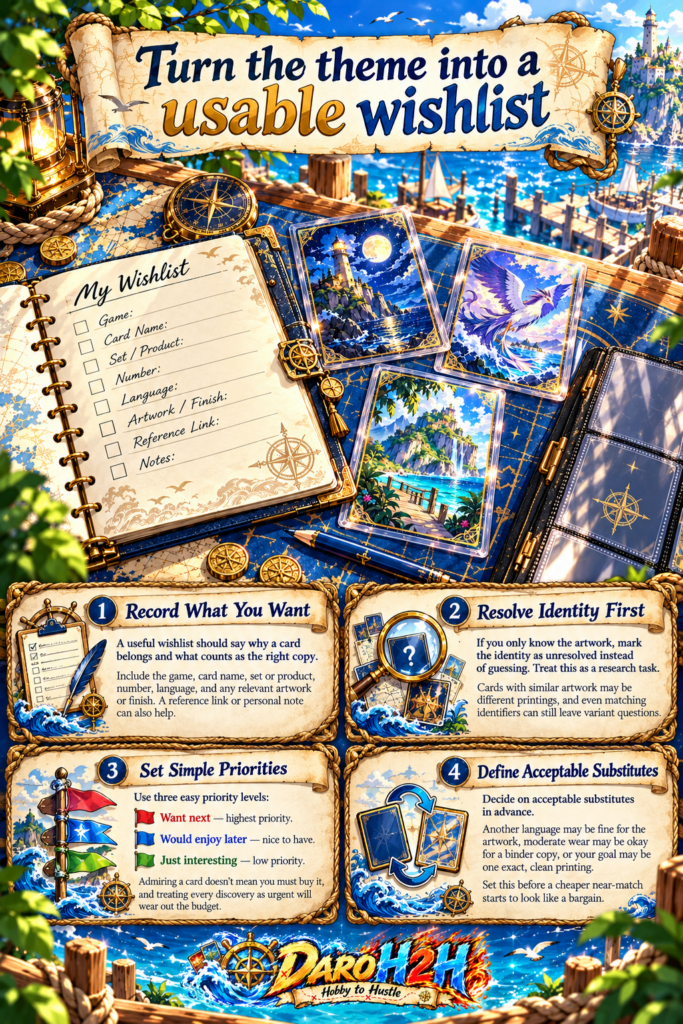
A wishlist is most useful when it tells you why a card belongs and what would count as the right copy. Record the game, card name, set or product, number, language, and relevant artwork or finish. Add a reference link or your own note where it helps.
If you only know the artwork, mark the identity unresolved. That is a research task, not a reason to guess. Before comparing prices, you want to know whether different offers describe the same printing. Similar-looking cards can have different identifiers, and matching identifiers can still leave variant questions.
Give each want a simple priority. “Want next,” “would enjoy later,” and “just interesting” are enough. That last group is useful because you are allowed to admire a card without turning it into a commitment to own it. A wishlist that treats every discovery as urgent will wear out your budget quickly.
Also write down acceptable substitutes. Maybe another language is fine because the illustration is what you love. Maybe moderate wear is acceptable in a binder copy. Or maybe the entire point is one exact printing in clean condition. Decide before a cheaper near-match starts looking like a bargain.
Choose a spending boundary that includes the small stuff
Pick an amount and a period that work with your actual finances. You might use a monthly limit, a saved amount for one project, or a rule that larger purchases wait until you have set money aside. The ceiling is a maximum, not a target you have to use up.
Define what counts toward it. Cards are the obvious part, but shipping, supplies, show admission, and other hobby costs can add up. If the budget is meant to cover the full project, don’t quietly leave those out when comparing a purchase. A card that fits only before shipping doesn’t fit the same limit after checkout.
As a hypothetical example, suppose your project has a $60 allowance for the month. You reserve $10 for supplies and delivery costs, leaving up to $50 for cards. You do not need to spend that $50. If the right card costs more than you’re comfortable paying, keep the money and keep the card on the list.
Avoid funding a purchase with a sale that hasn’t happened. Extras might eventually bring money back into the hobby, but a listed card and an estimated collection value are not cash available today. Selling can support the collection later without becoming the justification for spending beyond your present boundary.
Match the purchase format to the thing you want
If your goal names an exact card, start by comparing singles. You can inspect the offered version and decide whether the price and condition work. You aren’t paying for the possibility that the card appears somewhere inside a random product.
If opening packs is the activity you’re excited about, give that experience its own place in the plan. Pokémon Support describes boosters as randomized products. The practical question is whether you’d still feel comfortable with the cost if the target doesn’t appear. If the answer is no, the pack is doing a job it can’t promise to do.
Sealed products can also appeal because of their packaging, specified promo, or accessories. Read the exact product contents before deciding. A familiar family name isn’t enough to establish the same contents across releases, regions, or editions.
You can mix formats. A few carefully chosen singles and an occasional pack-opening session can coexist. Just keep the reasons and spending clear so a search for one card doesn’t silently become a much larger chase.
Give the first cards a simple home
Before bringing a lot of cards in, decide where you’ll put them. Start with suitable protection and storage that fit the actual cards and any sleeves or holders you plan to use. You don’t need the most elaborate setup on the shelf, but you do need to avoid forcing cards into an unsuitable pocket or crowded box.
For a themed binder, plan the page loosely enough to accept changes. You can arrange by character, story, color, or whatever makes the page enjoyable to open. A set project may benefit from an ordered checklist with deliberate gaps. A favorites page might look better without gaps for cards you don’t even want.
Keep a small record of what’s owned and where it lives. That can be as simple as a short list while the collection is small. The important thing is that your wishlist doesn’t keep recommending a card you already bought and your best purchase doesn’t disappear into an unmarked stack.
Walk through one complete example
Imagine a collector who loves one character but doesn’t want every version. The first goal becomes six favorite artworks in English, one copy of each. Three cards are already identified, and three slots remain open. A different language is not an acceptable substitute for this particular project, while minor wear might be.
The collector sets a comfortable monthly ceiling including shipping and supplies. One wanted card is available as an identified single within that boundary, with clear condition information. Another has only a vague photo, and a third costs more than the collector wants to spend.
There are three separate decisions here. The first card may be a purchase. The second needs more information. The third can wait. The project doesn’t require buying all three to count as progress, and buying the unclear card merely because it is available doesn’t improve the plan.
Now imagine a different collector who isn’t sure what they like yet. Their first step is browsing official references and sorting ten cards they already own. They spend nothing and discover a visual theme that interests them. That is also a successful start. The goal was clarity, not a checkout confirmation.
Review the plan after you’ve lived with it
Once you’ve made a few choices, look at the actual cards together. Are you excited to turn to that page? Does the project still feel manageable? Are you enjoying the hunt, or buying cards because a list says you should?
You can narrow the goal, change its boundary, or pause it. Keep a note of what changed so you don’t keep shopping from an old plan by accident. Cards that no longer fit can remain a separate mini-collection, move to an undecided group, or become possible trades. None of those decisions needs to happen immediately.
If you want help choosing the underlying theme, Choose a Collection You’ll Enjoy Keeping goes deeper on that part. For today, a short plan is enough: one theme, one boundary, a few exact wants, a spending limit, and the next purchase-or-wait decision.
Quick questions
How many cards should a first collection have?
There is no required count. Choose a size you can picture, afford, and enjoy. A small finished page can be a better first project than a huge checklist that immediately feels like homework.
Can I collect more than one game?
Yes. Give each project a clear purpose and keep the card systems distinct. You can share one overall hobby budget without pretending Pokémon and One Piece use identical identifiers or rarity conventions.
What if I want to open packs and buy singles?
Make room for both if your budget allows it. Treat the opening experience and the exact-card purchase as separate choices, each with a clear limit.
What should I do right now?
Write one sentence: “I’m collecting these cards because I like this about them, and for now I’m stopping here.” Add three wants and your spending boundary. If you can’t name the next sensible purchase, choose the next sensible question instead.