
One Piece cards give you a lot to collect before you ever think about a tournament deck: a favorite character, a crew, a story you love, an illustrator’s approach, or a page of artwork that looks great together. You can begin with that excitement and learn the card system as it becomes useful.
The trick is keeping the first project small enough to enjoy. “All the One Piece cards I like” can expand quickly. “A few favorite illustrations of this character” gives you a place to start, a way to compare choices, and permission to leave plenty of other cool cards alone.
This guide takes you through a first collecting plan, from the theme to an exact card or product decision. It uses Bandai’s English references and keeps personal collecting choices separate from organized-play requirements.
Choose the part of One Piece you want to put on the page
Start with what already interests you. A crew collection can bring different personalities together. A single-character project can show how different artists and releases approach the same person. A story-focused group can connect cards by the moments you care about, while an art-focused page can simply follow a visual mood.
You don’t need a rare centerpiece for the idea to work. A regular version that captures the character well can be more satisfying than an expensive variant whose illustration does less for you. The binder is allowed to reflect your taste.
Be clear about scope, especially if you’re collecting around a long-running story. Choose a limited group or a particular part of it rather than making every future release part of the assignment. If you’re still discovering the series, you can browse with care around story-related names and illustrations instead of assuming a product page will avoid spoilers.
A first boundary might be one page, six favorite artworks, or a small group with one chosen card per character. You can add another page later. Finishing a modest project can teach you what you want the next one to be.
Browse the card list with your theme in mind
Bandai’s official card list is the starting reference for the game. Its filters include card type and illustration type, giving you routes beyond simply searching a character name.
You might discover art on a type of card you weren’t initially considering. A collection doesn’t have to follow deck-building priorities: Leader, Character, Event, and Stage are useful game categories, but your personal page can bring together whatever verified cards fit its theme. Keep the actual type in the record when it helps you identify the card.
Save a small number of possibilities first. Put a note beside each one about what you like. That makes it easier to compare your own favorites after the initial excitement of discovering a new version wears off.
You are browsing to understand the choices, not to acquire every result. A card list can be a map without becoming your shopping checklist.
Learn the complete card number early
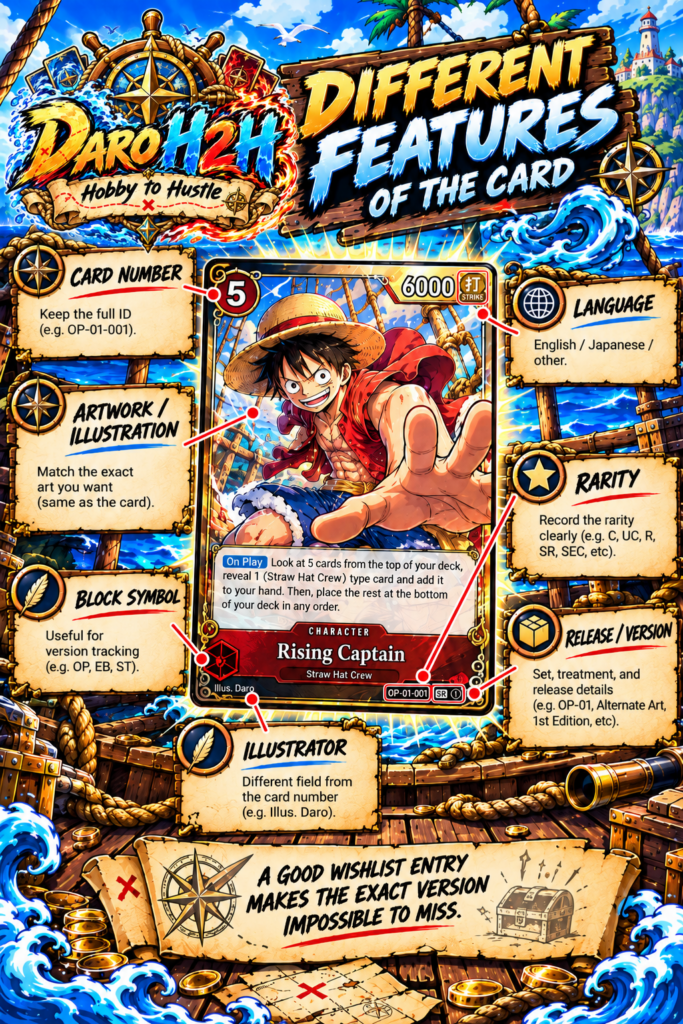
The number is one of the most useful pieces of information to copy. For a bounded example, Bandai’s Romance Dawn list includes Roronoa Zoro as OP01-001. Keep the entire identifier rather than reducing it to a character name or a few digits.
Now add the important collector detail: the official list has multiple entries and images under that identifier. If you want a particular illustration, the number alone doesn’t finish the job. Match the artwork, language, treatment, and relevant release information as well.
A useful wishlist line therefore says which card identity and which version you want. If you’re flexible about the illustration or language, record that deliberately. If the specific artwork is the whole point, make it impossible to miss.
Bandai’s Comprehensive Rules treat card number, rarity, block symbol, illustration, and illustrator as distinct information fields. You don’t need to memorize the rulebook to borrow that sensible separation for your collection record.
Keep variant excitement attached to something verifiable
One Piece collectors use plenty of shorthand, and Bandai also uses terms such as alternate art and parallel in its own product materials. The presence of an exciting label doesn’t tell you whether a seller and you mean the same printing.
Use the official number and a matching reference image underneath the nickname. Keep rarity separate from the artwork or finish description. If a listing says “special” or “manga” without enough detail to establish the exact item, ask what printing it describes instead of assuming the most desirable interpretation.
A nickname doesn’t establish official odds, print quantity, or future value. You can like a dramatic treatment because it looks fantastic. You don’t need to turn that enjoyment into a claim that it must be the smartest financial choice.
For a first project, choose whether multiple versions of one card are welcome or whether you want a wider mix. Otherwise a page intended to show several favorite characters can quietly become a search for every treatment of the first card you discovered.
Use product codes to find the exact release
One Piece product families commonly use OP for booster releases, ST for starters, EB for Extra Boosters, and PRB for Premium Boosters. The full code leads you to the relevant official product. The prefix by itself doesn’t establish the contents.
For example, ST-05 is the One Piece Film edition starter deck, while PRB-01 is One Piece Card the Best. Read each exact page for its specified cards, random contents, accessories, and regional details. Don’t import one product’s pack count or extras into another product with a familiar-looking name.
Also keep the product label separate from an individual card number. Returning cards can appear in later releases. If you know where a particular copy came from, record the provenance; if you don’t, preserve the uncertainty rather than treating its identifier as proof of the sealed product it came out of.
Decide whether you want a card or an opening
If your wishlist names one artwork, an identified single gives you the most direct offer to evaluate. You can check which version is being sold, its condition, the full purchase cost, and the transaction terms.
If opening packs is part of the fun, set a separate limit for that experience and accept that you may not get the target. Don’t read a product-wide list of rarity categories as the guaranteed contents of your individual pack. Use only explicit official guarantees, scoped to the exact product and unit.
A starter or boxed collection can make sense when its specified contents are what you want. But a collector seeking one card should still compare buying that card on its own. You don’t have to purchase a whole product simply because that is where you first saw the artwork.
For sealed collecting, the package itself can be the object you enjoy. That is a different goal from opening it for singles, and it still needs an affordable limit, a clear identity, and appropriate storage.
Walk through a small character project
Imagine a collector starting a six-card page of favorite Zoro illustrations. They want English copies for this project and prefer to choose six artworks they genuinely like rather than every numbered appearance. This is a hypothetical collecting scenario.
They browse the official list, save several candidates, and write down complete identifiers. When two images share a number, they add an artwork note and reference so the wishlist doesn’t confuse them. One candidate remains unresolved because the seller’s photo doesn’t show the treatment clearly.
The collector sets a total spending ceiling, including delivery and a basic storage setup. One single fits the plan and has enough evidence to evaluate. Another costs more than they want to spend. The unresolved offer needs a question before any decision.
That leads to one possible purchase, one wait, and one request for information. It doesn’t lead to buying a booster box in the hope that uncertainty will sort itself out. The page grows at a pace the collector is comfortable with, and its empty spaces remain invitations to discover something good.
Your own project might be a crew, a group of favorite scenes, or an artist. The method is the same: identify what fits, keep the boundary visible, and let individual offers earn their place.
Give the collection a record and a home
Use protection that fits the actual cards and any sleeves or holders involved. Don’t assume a pocket or box is suitable just because it is sold for trading cards generally. Check the relevant dimensions and product specifications, and avoid forcing a fit.
The published sleeves and holders guide can help you choose a setup. For a modest first collection, a simple, manageable arrangement is enough. Your binder doesn’t need to look like a retail display before the first page is enjoyable.
Record the cards as they arrive: identity, version, language, quantity, condition observations, and location. Keep purchase or trade history where useful. If a received copy doesn’t match the offer, preserve the packaging and records while following the seller or platform’s current resolution process.
Update the wishlist after the transaction is settled. It sounds obvious, but an old wanted mark can lead to buying a second copy when you intended to find something new.
Keep play eligibility on a separate checklist
If you want to enter events, start with Bandai’s current rules directory and the particular event’s instructions. Language rules, block updates, restrictions, errata, and physical-card requirements can matter. A collecting preference doesn’t override them.
Bandai’s block-number guidance includes Standard and Extra regulation as well as updates affecting particular card numbers. That is a reason to check the current reference, not to guess eligibility from a symbol alone. The restriction notices also have effective dates that matter for the event day.
If official documents appear inconsistent or you aren’t sure how a rule applies to your copy, ask the organizer or judge with the exact card details. This guide doesn’t approve a deck or maintain a legality database.
If you’re here for the artwork, you can leave that branch for later. A card doesn’t stop being enjoyable in your collection because a tournament rule changes.
Your first useful move
Choose one theme and one enough-for-now boundary. Identify a few real candidates, choose a spending limit, and research a single offer or exact product. Buy only if the version, evidence, terms, and total fit. Otherwise keep the plan and wait.
Then spend some time looking at the cards together. Notice which ones make the page feel like yours. That part is easy to lose when every conversation is about the next release, and it’s the part that makes the collection worth keeping.
Quick questions
Do I need to play One Piece to collect it?
No. Characters, stories, artwork, and the enjoyment of arranging a collection are enough reasons to participate.
Can two cards with the same number look different?
Yes. Match the actual illustration and other version details, not just the identifier.
Should a beginner collect the most expensive variants?
Only if a particular card genuinely fits the goal and an affordable budget. Price doesn’t decide whether the artwork belongs in your collection.
Can I mix languages in a binder?
That is your collecting choice. Keep language in the records and check separate requirements if you also intend to use those cards at organized events.