
You’ve got a handful of duplicates, a card that doesn’t fit your collection anymore, or maybe a small stack that’s been sitting on the desk since your last pack-opening session. You could keep them. You could trade for something you’re chasing. Or you could sell a few and put the money toward your next pickup.
Selling sounds simple until you start asking where to do it. A local card shop might make an offer right away. An online marketplace gives you more control, but then you’re making listings, dealing with fees, and figuring out shipping. And what if you’ve got ten cards that are individually worth very little? Spending your whole Saturday listing them one by one probably isn’t the dream.
There’s no single best place to sell trading cards. The right choice depends on the actual cards, how much work you want to do, how comfortable you are with the selling process, and what you’d rather be doing with your time. Here’s how I’d think through the options before choosing a platform.
First, what’s the actual goal?
Before looking up seller fees, figure out why you’re selling. That sounds basic, but it changes almost every decision after it.
If you’re clearing out some binder space, a quick local offer may be enough. If you’ve got one specific card and you care about choosing the asking price, an individual listing could be worth the extra work. If you’re just hoping to get rid of a box of low-value extras, a small lot might make more sense than separate listings.
Then think about what you’re willing to trade away: money, time, convenience, and control. Those are all real costs even when they don’t show up as a fee on your sales receipt. Getting a little more money doesn’t always feel like a win if you spend hours answering messages and packing orders to get it.
And if there’s a card you’d actually miss? Don’t sell it just because you found a price chart. Not every card has to earn its spot in your collection.
A local card shop: less work, usually a different kind of offer
Walking into a card shop with a small group of cards can be the easiest starting point. You can ask whether they’re buying the particular games or types of cards you have, show them what you’re offering, and hear what they’d be willing to pay. Some stores may pass entirely on certain cards or quantities. A shop isn’t required to buy your stack just because you brought it in.
The upside is that you can avoid building individual online listings, photographing each card, packing shipments, and dealing directly with distant buyers. The tradeoff is that a shop has operating costs, inventory risk, and a resale margin to think about. An offer from a store isn’t the same thing as the price a collector might pay you directly.
Don’t compare a shop’s offer to somebody’s highest online asking price and assume the shop is ripping you off. An asking price can sit there for weeks without a buyer. When you’re comparing values, completed sales for the same card, version, and condition usually tell a more useful story than optimistic listings. Even then, no comparison guarantees what your copy will sell for.
Ask a few straightforward questions before accepting anything:
- Is the offer cash or store credit? Credit might be useful if they have a card you want, but it isn’t money you can spend elsewhere.
- Are they buying the whole group? Make sure you understand which cards the offer actually includes.
- Are they grading condition on the spot? If their assessment differs from yours, ask why. You don’t have to agree.
- Can you take your cards back if the offer doesn’t work? Know the terms before you leave anything with a shop.
If you’re more interested in saving time than maximizing every dollar, a shop could be a good fit. There’s nothing wrong with choosing the easy route on purpose.
Online marketplaces: more control, more responsibility
Listing individual cards on a marketplace can be a solid option when you want control over the listing price, photos, descriptions, and which offers you’ll consider. Sites like eBay and TCGplayer publish seller fee information, but the details depend on the account and selling program. Check whether a platform currently supports your card category, location, and seller situation before doing a bunch of work.
A listing is more than a picture of a card and a number. You need to identify the exact card, set, printing, language, and condition. You need a description that matches what you’re actually sending. You need to understand how the marketplace handles payments, shipping, buyer complaints, returns, and seller protections. If something goes sideways, you’re the one who has to sort it out within that platform’s process.
The nice part? A careful listing can give buyers the information they need and lets you decide what you’re comfortable accepting. The less fun part is answering questions, watching unsold listings sit there, checking costs, and dealing with packing supplies. None of that makes online selling bad. It just means ‘I can list it’ and ‘I want to do all this work’ are two different things.
Also, an offer isn’t money in your account yet. Wait for the platform or payment provider to confirm what’s actually happened before sending anything. A screenshot of a payment notification isn’t proof by itself.
Selling a small lot: when ten listings would be nine too many
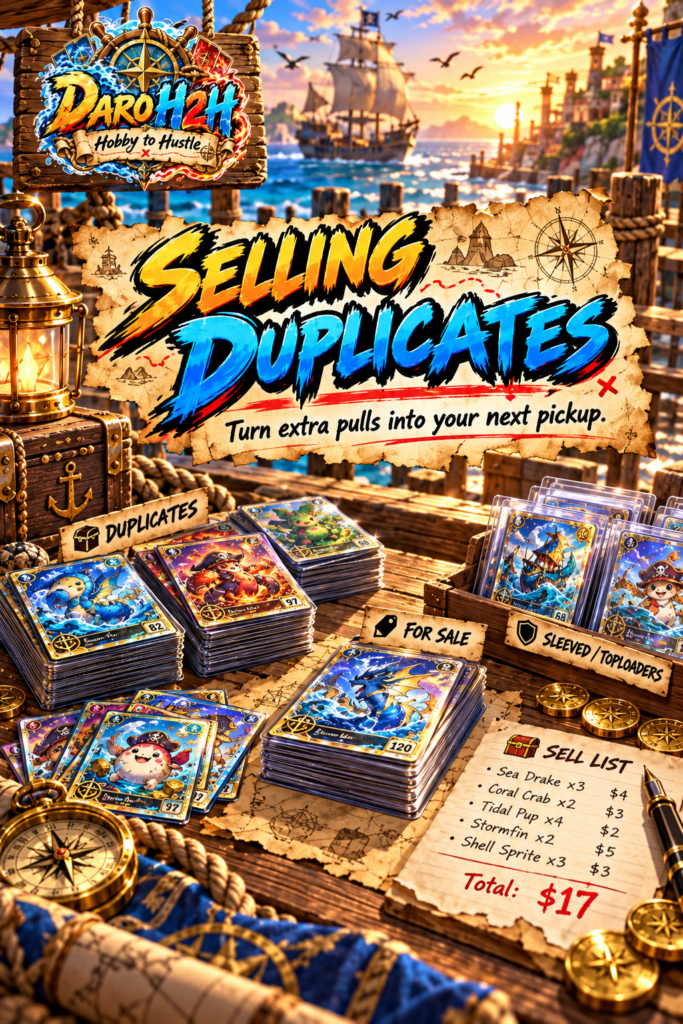
Imagine you have ten inexpensive duplicates. Maybe each one could technically have its own listing. But now you’re taking ten sets of pictures, answering ten possible questions, and maybe packing ten separate orders. Suddenly a little hobby cleanup project has its own administration department.
Grouping cards into one clearly described lot can save effort. It may be a sensible route for a stack of similar extras, a set of cards from one game, or cards someone might want together. A buyer taking a whole lot may expect a different price than the sum of individual asking prices, so don’t assume bundling guarantees a particular payout.
Be specific about what comes in the lot. If conditions vary, say that. If you’re showing a group photo, make sure the buyer can understand what they’re getting without guessing at the tiny card names in the back row. Never use a photo of valuable cards to imply they’re included when they’re not.
And if you’re not comfortable describing the cards accurately, you can pause, identify the lot first, and decide later. A rushed description is a lousy way to start a dispute.
What about collector-to-collector and local sales?
You might have an opportunity to sell directly to someone you know, at a local meetup, or through a community platform. These arrangements can feel more personal, but the details and protections vary a lot. A friendly conversation doesn’t magically replace clear terms about which card is being exchanged, condition, payment, and pickup or shipping.
For an in-person transaction, follow practical local safety practices and avoid taking unnecessary risks just to close a sale. For an online transaction, check what protections the platform actually provides. Keep messages, receipts, and shipment records where they matter.
The FTC’s guidance for people selling things online warns about fake payment notices, bogus overpayment requests, and verification-code tricks. Those are worth knowing before somebody tells you to move the deal outside the marketplace or send a refund for money you never actually received.
You can absolutely decide a deal feels off and walk away. A good card isn’t worth handing over your account information or meeting somebody in a situation that doesn’t feel safe.
The part everyone skips: how much do you actually keep?
A sale price can look pretty good until you start subtracting fees and costs. Marketplace commissions, payment or transaction charges, postage, packing supplies, and optional listing extras can all affect the amount left in your pocket.
For example, imagine a hypothetical sale where you collect $30 from the buyer, pay $5 in total marketplace charges, and spend $6 on shipping and packaging. That’s $19 left from that transaction before considering what the card originally cost you. Those are made-up illustration numbers, not eBay or TCGplayer fee quotes, shipping estimates, or a prediction of what any actual card will bring.
If you paid $15 to acquire that particular card, your economic result is different from what it would be if the card came out of a childhood binder and you have no reliable record of its original cost. That’s why it helps to keep amount received, selling costs, original cost, and what’s left in separate boxes instead of calling the entire sale price ‘profit.’
Taxes and business reporting are separate questions and can depend on your situation. This guide isn’t a tax opinion, and a hobby label on your social profile doesn’t settle how a transaction should be reported. Keep real records so you can handle those questions with appropriate current guidance later.
Don’t rely on a fee screenshot from a two-year-old video. eBay explains how listing types, categories, seller circumstances, and other choices affect fees, and TCGplayer shows different structures for different seller programs. The only useful rate for your decision is the one that actually applies to your sale.
A simple way to compare your options
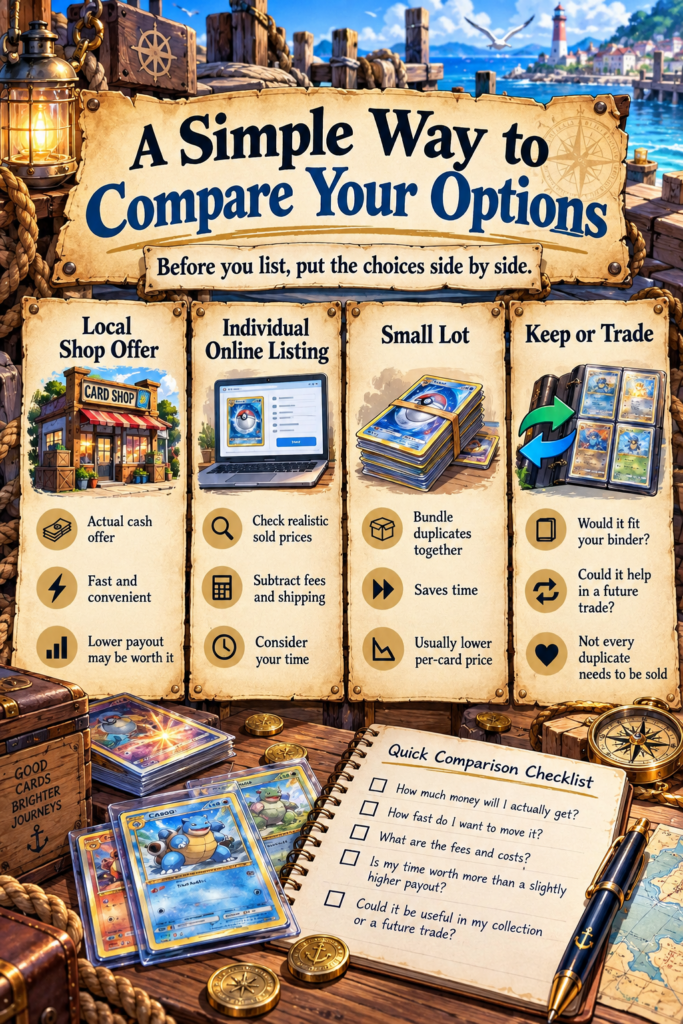
Before you start listing, put the choices next to each other. You don’t need an enormous spreadsheet. Just enough information to keep yourself from comparing apples, oranges, and someone’s optimistic asking price.
- Local shop offer: What is the actual cash offer? Are you okay with the convenience tradeoff?
- Individual online listing: What realistic sold-price evidence do you have, and what are your own fees, shipping costs, and time commitments?
- Small lot: Would bundling save enough time to justify the different likely price?
- Keeping or trading: Is the card more useful to you in the binder or as part of a future trade?
You may find that one card is worth selling individually while the rest of the pile belongs in a lot. That’s completely fine. There’s no prize for forcing every card through the same sales channel.
If you eventually use a sale-proceeds calculator, enter fees and shipping based on the platform rules and your own costs. A calculator should help you compare scenarios, not pretend it knows live marketplace rates or which card is going to sell next.
Don’t make shipping your surprise expense
Before you list a card, think about how you’ll actually get it to the buyer. A toploader is useful rigid protection for a compatible card, but putting that alone into an ordinary letter envelope can create problems. USPS notes that letters go through sorting machinery and warns against rigid objects loose in a regular envelope; rigid or bend-sensitive items may need a package service. Check its current mail guidance alongside the marketplace’s shipping and tracking rules.
That means two things for your listing: you need an honest estimate of your fulfillment costs, and you need a packing plan that matches the service you actually intend to buy. Don’t promise a shipping method just because it sounds cheap if your packaging doesn’t qualify for it.
For expensive or irreplaceable cards, don’t assume the cheapest option gives the tracking, proof of delivery, or loss protections you expect. Read the actual terms and choose deliberately.
When selling isn’t worth the hassle
Here’s a perfectly good answer that a lot of selling advice forgets: don’t sell it. If the card is one you still love, the sale would bring back very little after costs, or you simply don’t feel like handling another order, you can leave it in the binder.
You can give duplicates to someone starting out, put them into a trade pile, or keep them until you have enough to make a lot worth listing. There’s no deadline on making the collection financially productive. The Hobby to Hustle part is there when it helps you enjoy cards, not to turn your free time into unpaid customer service.
Quick questions
Will a card shop pay what my card lists for online?
Don’t count on that. Online asking prices aren’t completed sales, and a shop has inventory costs and a resale margin. Compare an actual offer with realistic alternatives, not the highest listing you can find.
Is eBay or TCGplayer always cheaper for sellers?
No. The fee structures vary by platform, seller type, category, order, and program features. Check the current official fee pages for the exact sale you’re planning.
Should I list every duplicate separately?
Only if the result seems worth your time. A lot, a trade, a gift, or simply hanging on to extras may be better choices for low-value cards.
Do I need to ship the card as soon as somebody sends a payment screenshot?
No. Verify payment using the actual marketplace or payment provider, not an image or forwarded email. Follow the marketplace’s shipment and seller-protection rules.
Make the next move easy
If you’re curious about selling, pick one card or small group that you’re genuinely comfortable parting with. Identify it carefully, check a few relevant completed sales, look at the actual selling fees, and estimate shipping before you create a listing. You may decide to sell. You may decide a trade makes more sense. Either way, now you’re making a choice instead of guessing.
Want to keep the hobby side in view while you do that? Revisit what you’re collecting toward. Selling an extra feels a lot more worthwhile when you know which card you’re hoping to bring home next.